
Internal Control Failures: A Growing Web of Risk Factors
Uncovering How Expanding Risk Dynamics Weaken Internal Control Effectiveness
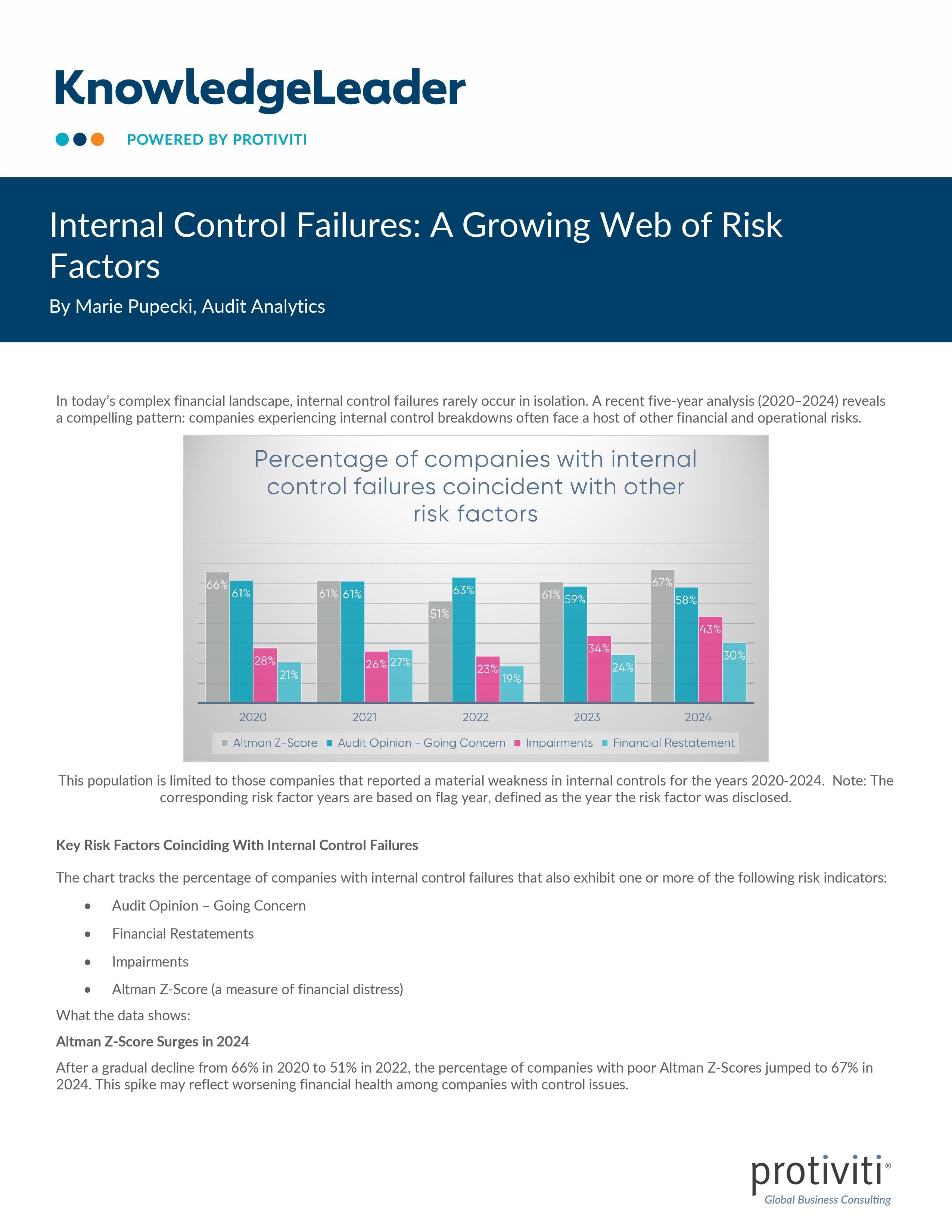
When internal controls falter, it’s rarely an isolated incident. These breakdowns often set off a chain reaction of deeper financial and operational risks. Over the past five years, data reveals a striking pattern: companies grappling with control failures are much more likely to face other warning signs, including troubling Altman Z-Scores, doubts about their ability to continue as a going concern, asset impairments, and the need to restate financial results. This web of interconnected risks underscores why strong internal controls aren’t just about preventing mistakes. They’re a crucial early warning system for looming instability.
Now more than ever, the stakes are high. Recent trends show a surge in financial distress signals, with poor Altman Z-Scores and asset impairments climbing sharply in 2024. For leaders, auditors and investors, this means vigilance and transparency are essential. Scrutinizing control environments whenever other risk factors surface, responding quickly to weaknesses, and treating control failures as urgent red flags can make all the difference. In today’s environment, robust internal controls are the bedrock of corporate stability and investor trust, making their health a top priority for anyone who cares about long-term success.
Notable points include:
- Internal control failures rarely happen alone—they tend to cluster with other serious risks.
- Signs of financial distress, like poor Altman Z-Scores and asset impairments, are on the rise.
- Stakeholders must act quickly and transparently when control issues appear.
- Healthy internal controls are a vital signal of overall corporate resilience.